

The biggest wedding hairstyle trends for 2026 are softer than last year. Sleek ponytails, lived-in updos, oblong buns, and bouncy half-ups dominate the bookings we're seeing this season. Brides are stepping away from sculpted, frozen-in-place looks and choosing styles that move, photograph well at different angles, and hold up through eight hours of hugs, dancing, and humidity.
Wedding hairstyle trends are the bridal hair looks gaining the most demand each season, shaped by current celebrity styling, runway influence, and what real brides are booking with stylists. For 2026, that means romantic textures, soft volume, and intentional imperfection. Polished but never stiff. Personal but still photo-ready from every angle.
We see this play out at every booking inquiry. Brides arrive with three Pinterest boards and one question: will this still look right in twenty years? That question matters more than which trend is hottest. A trend that ages badly turns into a wedding photo regret. The four styles below pass the longevity test. They're current without expiring. If you're searching for trends to bring to your trial, this list is where I'd start. For full pricing and how each look translates to your hair type, our team that handles bridal styling in the DMV area has a breakdown by service tier.
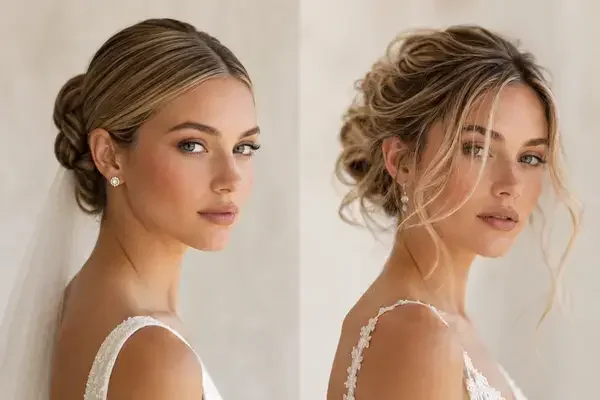
What's Driving the 2026 Bridal Hair Shift?
The shift is real, and it's a reaction to 2025. Across the bookings we've taken this year, brides are walking in with reference photos that look noticeably softer than the ones we saw twelve months ago. Less sculpted. More movement at the lengths. Texture you can run your fingers through without breaking the shape. The industry consensus, echoed by senior stylists across major editorial publications this season, is that 2026 is more refined and intentional than the loose, overtly undone looks that defined 2025. Both can be true at once. Texture is back, but it's controlled texture.
The data backs the shift too. The Knot's 2026 Real Weddings Study surveyed 10,474 U.S. couples married in 2025, and 72% of them hired professional beauty pros. That's not a fringe choice anymore. It's the default. And the average bride paid around $150 for hair styling, with full bridal beauty (hair + makeup) running $300 nationally. Once you're spending that, you want a style that actually fits you, not whatever was trending six months ago.
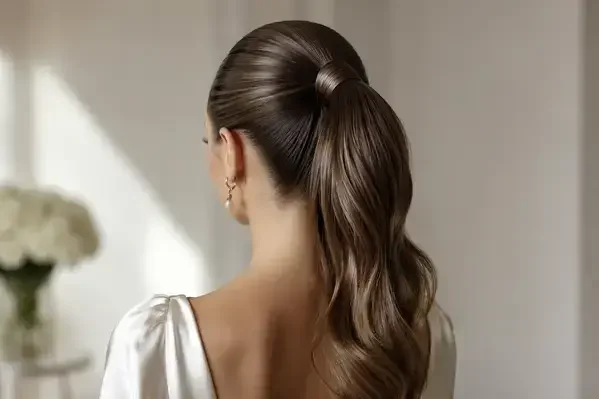
Is the Party Pony Actually a Wedding Hairstyle?
Yes, and it's one of the strongest 2026 bridal hair trends if you want one look that works for ceremony and reception. The party pony is a high-set, sleek ponytail with a smooth crown and either a glassy finish or soft, brushed-out texture at the lengths. Done well, it photographs like a couture editorial. Done badly, it photographs like a workout.
Who It Works For
Long natural hair or natural plus clip-ins works best. Oval, heart, and oblong face shapes carry it cleanest because the height adds balance. Round face shapes can wear it, but the position needs to be slightly lower (mid-crown, not high-crown) to avoid pulling features tight.
What to Watch Out For
Two things ruin a party pony. First, a weak base. If the gather point doesn't hold, the whole style drops two inches by the first dance. Second, a flat wrap. The hair that wraps the elastic has to be set, not just twisted. We typically build the base with structural pins and finish the wrap with a smooth section pulled from underneath the pony itself. Veils attach easily here, which is one reason brides searching for modern bridal hair in DC ask about it more than they did last year.
High Tousled Wedding Updo: Romantic Without the Stiffness
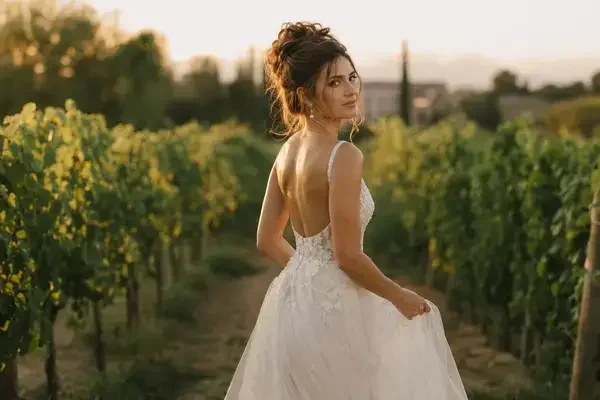
The high tousled updo is the romantic answer to the party pony. Same crown height, but the hair is pinned into an airy, loose shape with face-framing pieces left down. The whole point is to look like you woke up at a French country house and someone happened to be a hairstylist.
This is the style most brides describe with words like soft or undone, but the build under the hood is actually structured. The texture comes from prep work: heatless overnight rollers, sea-salt mist, and a powder root lift. Then it's pinned in sections and broken apart by hand at the end. The looseness is the finish, not the foundation.
Best Venues for This Look
Outdoor venues, garden weddings, vineyard weddings, and any setting with movement. Wind makes this style better, not worse. Indoor ballrooms with low ceilings can flatten the silhouette in photos, so a slightly higher placement helps.
Hair Length You Need
Shoulder length minimum. Below the shoulder is the sweet spot. Shorter than the chin, the style won't pin in the way it needs to. Clip-in extensions solve this for most brides who've been growing hair out for the wedding and ran out of runway.
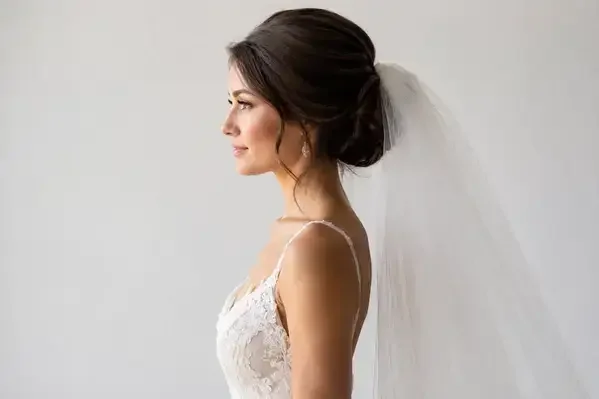
Why the Chic Oblong Bun Is Replacing the Classic Chignon
The classic round chignon is starting to feel dated. The oblong bun is the 2026 replacement. Slightly elongated, intentionally off-center in places, and softer in shape, it gives the same elegance without the museum-piece stiffness.
The oblong bun has range. It works for minimalist gowns, structured silhouettes, and traditional cathedral veils. The asymmetry photographs well in three-quarter and profile shots, which most wedding photographers favor for the ceremony portrait. A round bun, by contrast, often disappears in profile shots because it reads as a flat circle behind the head.
Veil Compatibility
Anything from a birdcage to a cathedral works. The oblong shape leaves a natural attachment point at the back-crown intersection. That's where most veil combs sit anyway, so you're not fighting placement. If you're booking wedding hair in Leesburg, Baltimore, or Philadelphia, ask your stylist to mock the veil attachment during your trial, not on the day.
Honest Take
This style is the safest bet on the list for brides who want photos that age well. It's the bridal equivalent of a navy suit. Hard to do wrong. Easy to look at twenty years later without wincing.
Bouncy Half-Up With Extensions: The Most Underrated Choice
The bouncy half-up is the trend most brides don't consider but should. It's the middle ground between an updo and hair worn fully down. You get the romance of long flowing hair plus the structure of a styled crown.
Clip-in extensions are doing a lot of the work in this look for 2026. Even brides with naturally long hair are adding clip-ins for body and curl support, because a flatiron curl on natural hair drops by hour four. Premium clip-ins from brands like HÂS hold the shape longer because the weight pulls the cuticle into a tighter spiral. Worth noting: extensions aren't free. Day-of clip-ins typically add $30 to $50 to the base bridal hair total based on platform averages, and many DC-area wedding hair teams bundle this into a styling package rather than charging it separately.
Common Question: Will They Slip?
Only if they're installed wrong. Clip-in extensions slip when the stylist doesn't section into a thick enough anchor of natural hair. We section into braid pockets at the install points, which gives the clip something dense to grip. Done correctly, the extensions outlast the styling itself.
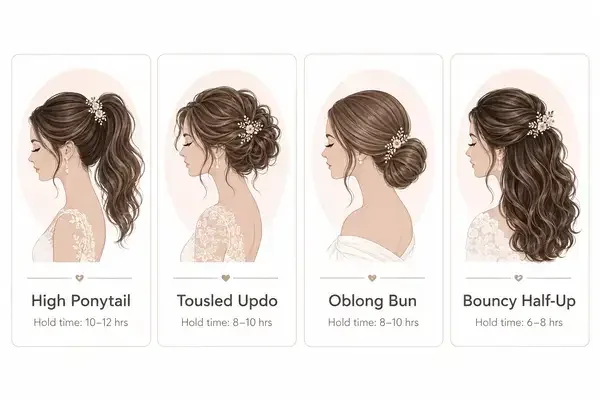
Wedding Hair Trends 2026 Compared Side by Side
Use this section to narrow your shortlist before your trial. Pricing reflects national averages plus typical add-ons. Regional differences are noted in the FAQ.
The party pony and chic oblong bun share the longest hold at 8-10+ hours. The party pony works best on oval, heart, and oblong face shapes and pairs cleanly with a veil attached at the mid-crown. The chic oblong bun works on all face shapes and is the strongest veil pairing of the four styles.
The high tousled updo holds 6-8 hours, works on all face shapes, and accepts a back-crown veil attachment cleanly. The bouncy half-up has the shortest hold at 5-7 hours. It suits round, square, and oval faces, but veil options are limited to a low veil only.
Two things to flag. The party pony and oblong bun hold longest because the gather point is structural. The half-up is the shortest hold because the loose hair takes the most movement abuse. If your reception is a five-hour dance party, that matters. Pricing for each style is covered in the cost section below, since per-style ranges vary based on length, extensions, and region rather than the style itself.
How Much Does Wedding Hair Cost in 2026?
The national average for a bride's wedding-day hair styling is $150, with full bridal beauty (hair + makeup) averaging $300, according to The Knot's 2026 Real Weddings Study. Regional pricing varies more than most brides expect.
The Northeast/New England and Mid-Atlantic tie at the top at $360 for bride's hair plus makeup. The West Coast follows at $320. The South and Southeast average $290, the Southwest sits at $280, and the Midwest is lowest at $260.
Northeast and Mid-Atlantic brides pay roughly 38% more than Midwest brides for the same service tier. That gap reflects competition for top stylists in dense markets, not better hair. Trials add $225 to $350 on top of the day-of price, and most stylists expect 15 to 25% gratuity on the full beauty total.
Budget vs. Mid-Range vs. High-End Bridal Hair
Pricing tiers from platform data break down predictably. Budget bridal hair runs $100 to $150 for a simple updo or blowout with no extensions. Mid-range sits at $150 to $250, typically textured waves with face-framing pieces and a trial included. High-end starts at $300 and climbs for elaborate sculpted buns, extensions, multiple artists, or airbrush finishing. Upper-quartile total bridal beauty (hair plus makeup) reaches $390 nationally.
Here's the contrarian take most articles skip. Skipping the trial is the single most expensive mistake brides make. The trial isn't optional and it isn't a luxury. It's the only place you find out that your hair doesn't hold the curl pattern you saw on Instagram, or that the veil flattens the back of the updo, or that your stylist hasn't worked with your hair texture before. Brides who skip trials regularly spend $300 to $500 on last-minute redos or replacement stylists. That's not a savings. Booking atrial run through our bridal services page runs less than the cost of a redo.
What Should You Ask a Wedding Hairstylist Before Booking?
Most brides ask the wrong questions. They ask about Instagram portfolios and pricing. They forget to ask about the things that actually go sideways on the wedding day.
The questions that matter:
1. What's your experience with my specific hair type or texture, especially if I have curly, coiled, or fine hair?
2. Does the quote include travel fees, gratuity, and touch-up time, or are those add-ons?
3. What's your backup plan if you're stuck in traffic or sick on the wedding day?
4. How do you handle veil interaction in photos, and will you stay for the veil removal during reception?
5. Will you bring backup product for humidity, sweat, and dance-floor movement?
The texture question is the most underrated. Many bridal stylists trained almost exclusively on straight or wavy hair, and the work shows when a coily or 4c bride sits in the chair. The Professional Beauty Association maintains a directory of pros and continuing education programs, which is a reasonable starting point if your stylist's portfolio doesn't show your texture.
How Far in Advance Should You Book Your Wedding Hairstylist?
Six to twelve months out for popular stylists in high-cost regions. Earlier for destination weddings, summer weekends, and any Saturday in peak season (May, June, September, October).
The wedding industry isn't slowing down. The same 2026 study puts the U.S. wedding market at roughly $100 billion with about 2 million couples marrying in 2025. The Bureau of Labor Statistics projects 5% employment growth for hairstylists and cosmetologists from 2024 through 2034, which is faster than average across all occupations. The top wedding pros are still booked out 8 to 12 months in advance because demand for elite stylists outpaces supply in metro markets.
Should the Bride Pay for Bridesmaids' Hair?
No industry rule exists. The average across U.S. couples is $210 per party member for hair and makeup combined when the bride covers it. Some couples split, some cover only the bride, some cover hair but not makeup.
Practical advice from booking hundreds of bridal parties: clarify it in writing six months before the wedding. The fight isn't about the money. It's about the surprise. A bridesmaid who learns at the trial that she's expected to pay $210 unexpectedly is going to be unhappy for the next four months.
Are Hollywood Waves Still Trending for 2026?
Yes, but with edits. The tightly sculpted finger-wave is fading. The 2026 version is softer, with more curl bounce and less wax. Modern Hollywood waves stay in rotation because they photograph beautifully under direct light, which most ceremony spaces have. The wrong version of this look (flat, lacquered, frozen) is the most-aged-poorly bridal style of the last decade. The right version is timeless.
How to Pick the Right 2026 Wedding Hairstyle for You
Don't pick the trendiest. Pick the one that fits your venue, dress, hair length, face shape, and the energy of the day you're actually planning. A high tousled updo at a barn wedding is a different choice than the same style at a city hotel ballroom. Bring photos to your trial, but bring questions too.
The 2026 wedding hairstyle trends worth booking are the ones that look like you, only on the best day of your life. Pony, updo, oblong bun, or half-up: any of the four ages well when the foundation is right. When you're ready to plan yours, the team behind our studio walks every bride through the texture, longevity, and veil decisions before the trial begins. Working with an experienced search and content team is how this article reached you in the first place. The same logic applies to choosing your stylist: experience in your specific scenario beats a generic portfolio every time.
FAQs
What are the top wedding hairstyle trends for 2026?
The four leading 2026 wedding hairstyle trends are the high party pony, the tousled updo with face-framing pieces, the chic oblong bun, and the bouncy half-up with clip-in extensions. All four favor soft texture and movement over the sculpted, frozen looks that defined 2025.
Do I really need a hair trial for my wedding?
Yes. Skipping the trial is the most common bridal hair regret. Live lighting, veil weight, and hair movement during dancing all differ from any photo on Instagram. A trial gives you the chance to test how the style holds, how the veil attaches, and how the look photographs from every angle before the wedding day.
How far in advance should I book a wedding hairstylist?
Six to twelve months for top stylists in metro markets and 12 months or more for destination weddings. With around 2 million U.S. couples marrying each year, demand for the best pros stays high in every region, especially for Saturdays in May, June, September, and October.
Which wedding hairstyle trend lasts longest through a reception?
The oblong bun and the high party pony hold the longest at eight to ten or more hours, because both rely on a structural gather point. The bouncy half-up has the shortest hold (five to seven hours) because the down portion absorbs the most movement during dancing.
What wedding hairstyle works best for my face shape?
Oval, heart, and oblong face shapes carry high-set styles like the party pony and tousled updo cleanly because added height balances the face. Round and square shapes look best with softer, lower placements like the oblong bun or a half-up with curl falling around the jawline. The tousled updo flatters all face shapes when positioned thoughtfully.
Can I wear a veil with any wedding hairstyle trend for 2026?
Most 2026 wedding hairstyle trends accommodate veils, but placement matters. The oblong bun pairs with any veil length from birdcage to cathedral. The party pony and tousled updo both work with mid-crown or back-crown veil attachments. The bouncy half-up is the most restrictive, working only with low-set veils that don't compete with the styled crown.